
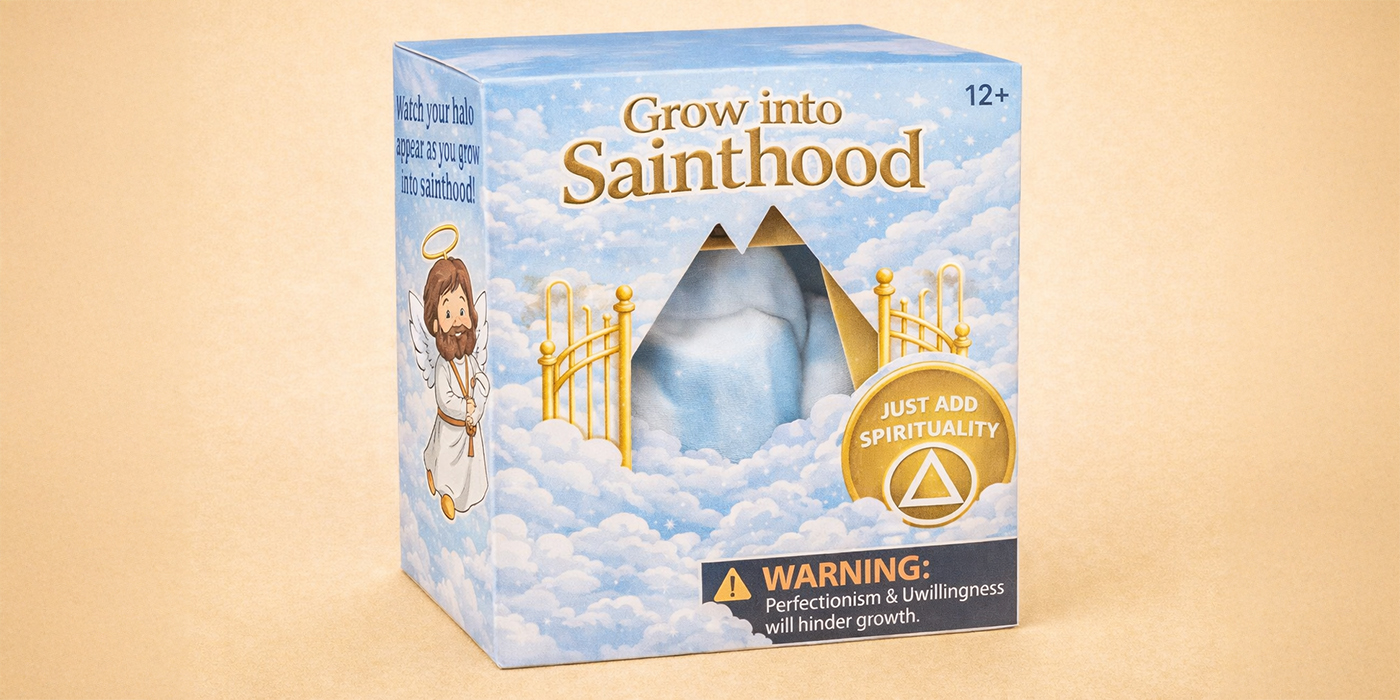
This member finds hope by not leaving out the possibility of one day becoming a saint.
This morning in my meeting, we read from Chapter 5 of Alcoholics Anonymous, which is occasionally referred to in AA meetings as “the preamble”. It was a reminder to me of my group’s pre-COVID days, our face-to-face meetings, which have now become entirely too infrequent.
In those meetings, before we were forced to migrate to the virtual world to hold on to our sobriety, we used to read this as our own preamble, substituting the White Book’s version of Chapter Five from the Big Book.
I jotted down some notes as I was listening today.
Many of us exclaimed, ‘What an order! I can’t go through with it.’ Do not be discouraged. No one among us has been able to maintain anything like perfect adherence to these principles. We are not saints. The point is, that we are willing to grow along spiritual lines. The principles we have set down are guides to progress. We claim spiritual progress rather than spiritual perfection (AA 60).
This is the Program’s way of immediately taking the pressure off. After having just laid out what can sound like a tall, intimidating, even impossible order—complete surrender, moral inventory, amends, lifelong maintenance, daily contact with God, carrying the message—and then saying: “Yeah, we all felt exactly the same way. Relax. None of us does this perfectly, ever. We’re not saints. All that’s required is a willingness to keep growing.”
In early recovery, that single paragraph kept me from bolting out the door. It’s the antidote to perfectionism, which is deadly for an addict like me.
Then it distills the entire program into the three “pertinent ideas”, the program’s ABCs:
(a) That we were addicts and could not manage our own lives.
(b) That probably no human power could have relieved our sexaholism.
(c) That God could and would if He were sought (AA 60).
These three sentences are the core of the Program’s message:
A: We’re powerless (Step 1)
B: Greater power can help (Step 2)
C: God can and will if sought (Steps 3-12)
Everything else—the Steps, the stories, the Fellowship—is just the practical “how” of moving from (a) to (c).
When I was asked to read this in our meetings, I added the word “yet” to the sentence: “We are not saints.”
It’s cheeky, it’s hopeful, and honestly, it lines up beautifully with both the Big Book and my faith tradition’s understanding of sanctity.
The Big Book is crystal-clear; “We are not saints” is present tense, a description of where we are right now, not a permanent verdict on what we can become. Adding “yet” doesn’t contradict the text; it just refuses to close the door on grace.
In meetings, some people bristle at adding “yet” to that sentence because they hear it as a sneaky return of perfectionism—“Oh great, now I’m supposed to become a saint?!” But if it’s coming from a place of hope instead of pressure, it’s pure Twelfth-Step energy: “Keep going; you’re not done growing; the best is still ahead.” That’s the opposite of the spiritual despair that kept me drunk.
I’ve heard old-timers say things like: “We’re not saints, but some of us are getting pretty sanctimonious!” (usually followed by laughter), or “I’m not a saint yet, but I’m a hell of a lot closer than I was when I walked in.”
That little “yet” is in good company. It keeps the horizon open without beating anybody up.
So, I keep sneaking the “yet” in occasionally when I read it. It’s a quiet act of hope, and hope is what newcomers need to hear between the lines anyway.
Anonymous